


There are many types of power supplies available today. It would help if you choose a power supply for a Pixel LED project. There are two types of power supplies available on the market: linear power supplies and switch-mode power supplies (S.M.P.S.).
Table of Contents
Linear Power Supply for a Pixel LED
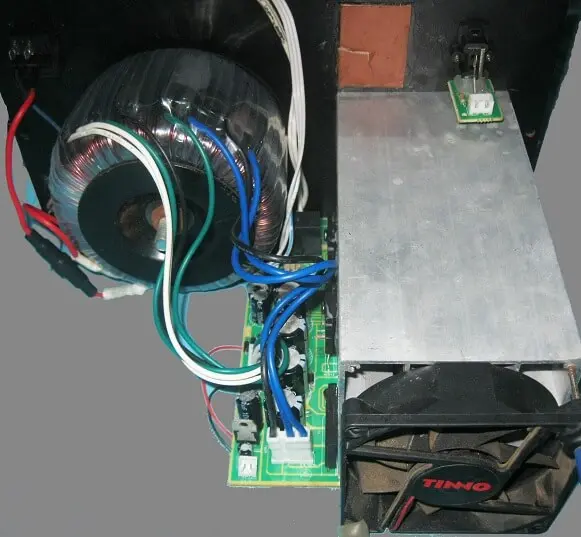
It's a power supply that uses linear transformers to regulate the voltage. The working principle is based on mutual induction. These power supplies have large transformers (depending on the output current and voltage). To convert the AC output of the transformer to DC, this power supply has half or full bridge rectifiers (depending on the type of transformer) and then smooths that voltage using capacitors.
S.M.P.S (Switch Mode Power Supply)

It's a power supply that uses special transformers with switching circuits and feedback circuits to regulate the voltage. This type of power supply uses high-frequency switching. Since it uses high-frequency switching, we can reduce the number of coil turns per winding, which will reduce the size.
A full-bridge rectifier converts the AC supply voltage to a DC voltage. Then the primary winding of the chopper transformer is switched to high frequency using an F.E.T., which will cause the secondary winding current to flow. That voltage is then converted to a DC voltage using a single Schottky diode. The high frequency is filtered using a coil in series, and then the voltage is smoothed using capacitors.
For pixel LED projects, we use S.M.P.S. instead of linear power supplies for multiple reasons.
Pros (S.M.P.S)
- High efficiency.
- Small in size.
- Less weight.
Cons (S.M.P.S)
- R.F. interference on close electronic equipment (LED lamps, etc., other S.M.P.S.
- E.M.F. interference.
Voltage and current
The rating of the S.M.P.S. for your Pixel LED project depends on these things:
- Number of LEDs.
- Number of LED controllers.
- LED layout size.
- Working environment.

Pixel LED Effects Download Pack: 7000 Effects
- Files: 7000+
- Size: 25 GB
- Formats: SWF, TOL, AVI, MP4, and GIF
Voltage and current ratings of the power supply
The voltage rating for LED strings and controllers is usually 5 volts (this may change with the controller model and Pixel LED string type). Contact your seller or the manufacturer for the correct voltage rating.
How to calculate the current rating requirement of the power supply:
Maximum current is taken when a pixel LED is illuminating in white. R.G.B. values (255,255,255). The current taken by the Pixel LED depends on the type of Pixel LED you are going to use. The current taken by the driver chip can be found in the datasheet.
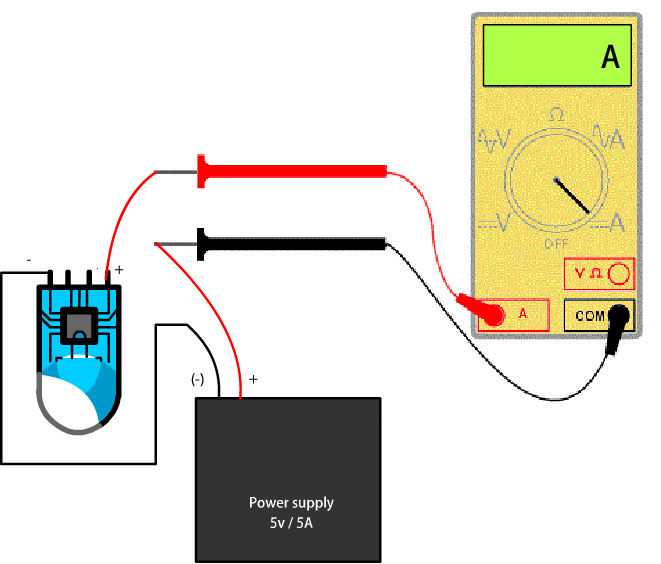
You can also check the pixel LED current by powering up a single pixel LED without data and checking the current taken by it using a multimeter. Connect the multimeter probes in series with the LED and the power supply (put the multimeter on the amp scale).
First, let's calculate the current taken by a one-pixel LED.

Now, let's calculate the current taken by all the Pixel LEDs.

Let's calculate the current taken by the controllers.

Let's calculate the power supply minimum current requirement.

Finally, let's calculate the recommended power supply current requirement.
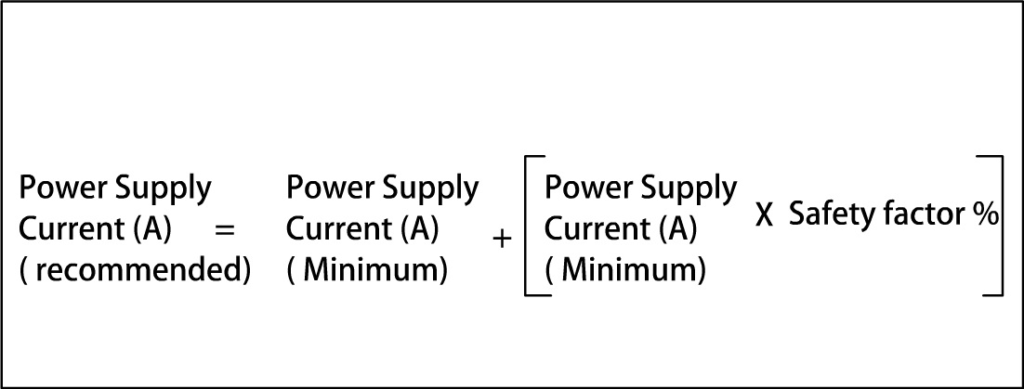
We use 50 as the safety factor, which means one-half of the minimum power supply current value is the recommended power supply current. Using the above equations, you can calculate the current power supply requirements.
Power supply network
If you are doing a large-pixel LED project, it's very hard to find a single power supply with a large current output capability. Don't worry! You don't have to use a single power supply. You can use multiple power supplies to create the required current rating, but make sure to connect the (–) or (GND) of all the power supplies together.
Here is an example of multiple controllers with multiple power supplies.

In the above example, we have 3 power supplies with a 40A current output, which means that together they produce a 120A current output.
Here is an example of Pixel LED strings powered by separate power supplies.
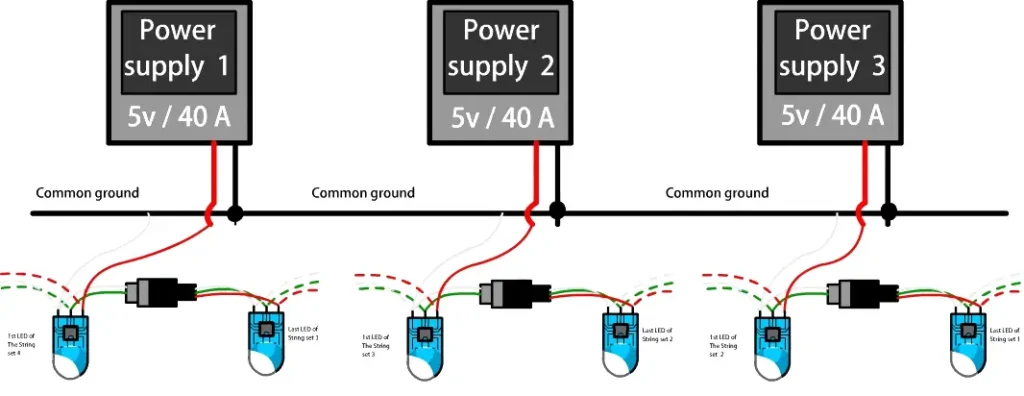
In the above example, three sets of Pixel LED strings are powered by separate power supplies. The first LED of the string set is connected to a separate 5V/40A power supply instead of a single 120A power supply. Make sure that the (–) or the (GND) of every power supply is connected.